 Reviews



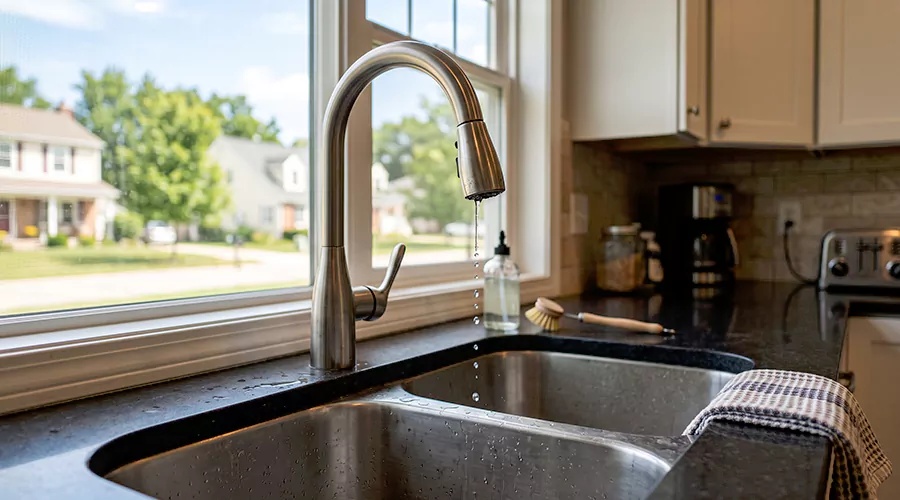
A faucet usually leaks because a washer or internal cartridge can no longer form a complete water seal. In some designs, damaged O-rings or worn valve seats are responsible. Professional leaky faucet repair costs approximately $100–$400 in the United States according to July 2026 pricing data. Faucet repair can address worn washers, damaged O-rings, faulty cartridges, and other common causes of faucet leaks.
The location of the water provides the first diagnostic clue. A drip from the spout usually involves the internal shutoff mechanism. Moisture around the handle or faucet base may indicate a different sealing problem.
Finding the correct source matters because tightening the handle cannot repair every type of leak.
What Are the Most Common Causes of a Leaking Faucet?
A faucet controls water through internal sealing components. Repeated operation gradually wears these parts. Sediment and mineral deposits can also interfere with the surfaces that normally stop water flow.
Common causes include:
- Worn washers: Rubber components lose their ability to seal against the valve seat.
- Damaged cartridges: Internal sealing surfaces become worn or obstructed.
- Deteriorated O-rings: Water escapes around moving faucet components.
- Damaged valve seats: Rough surfaces prevent washers from forming a complete seal.
- Mineral buildup: Deposits interfere with internal component movement.
- Loose connections: Water escapes around mounting or supply fittings.
- Internal corrosion: Deterioration damages sealing surfaces and other components.
The exact cause depends on the faucet design.
A compression faucet operates differently from a modern cartridge faucet. Therefore, replacement components are not interchangeable between all models.
How Can You Identify Where the Faucet Is Leaking?
The location and timing of the leak help narrow the problem. A spout that drips after the handle is closed points toward internal valve sealing. Water that appears around the faucet base while it is operating may involve another component.
| Leak Location | Possible Cause | Initial Investigation |
|---|---|---|
| End of spout | Internal washer or cartridge | Observe dripping after shutoff |
| Around handle | Cartridge seal or O-ring | Inspect while faucet operates |
| Around spout base | Spout seal or internal connection | Dry and test the base |
| Beneath sink | Supply fitting or faucet connection | Inspect under-sink plumbing |
| Around mounting area | Faucet seal or water entering from above | Check countertop connection |
| Persistent drip after repair | Incorrect part or damaged valve surface | Recheck model and components |
The location should guide inspection rather than determine the replacement part automatically.
A leak beneath the sink can travel along a supply hose before forming a visible drop.
How Much Water Can a Leaking Faucet Waste?
A slow faucet leak can waste more water than its appearance suggests.
According to the U.S. Environmental Protection Agency, a faucet dripping at approximately one drip per second can waste more than 3,000 gallons of water annually.
The EPA also reports that correcting common household leaks can reduce water bills by approximately 10% for some households.
Actual water waste depends on the drip rate and duration.
A continuous trickle wastes more than an occasional drop.
Therefore, a leak should be investigated even when it has not yet created visible water damage.
What Warning Signs Indicate a Faucet Leak Is Getting Worse?
A faucet may develop additional symptoms as its internal parts wear. Changes in the handle's movement or the location of moisture can help reveal the problem.
Watch for these warning signs:
- The spout continues dripping after shutoff.
- The drip becomes more frequent.
- Water appears around the faucet handle.
- The handle requires increasing force to close.
- Mineral deposits accumulate around the spout.
- The faucet becomes unusually stiff.
- Water collects around the mounting base.
- Moisture appears beneath the sink.
- A previous repair stops working.
- The faucet develops a continuous trickle.
A leak beneath the sink deserves prompt attention because water can remain hidden inside the cabinet.
The EPA recommends checking exposed fittings and faucet components for signs of moisture.
Why Does a Faucet Drip After Being Turned Off?
A faucet that continues dripping after shutoff usually has an internal valve that no longer seals completely.
In compression designs, a rubber washer presses against a valve seat.
Modern cartridge faucets use different internal sealing components.
Wear or damage can allow water to pass through even when the handle is fully closed.
A few remaining drops immediately after shutoff can sometimes be water draining from the spout rather than an ongoing supply leak. However, continued dripping over several minutes suggests that water is passing through the closed valve.
Observe the faucet long enough to distinguish these conditions.
Can Hard Water Cause a Faucet to Leak?
Mineral deposits can interfere with faucet operation and contribute to internal wear. Calcium deposits may form around the aerator or accessible faucet surfaces.
Deposits can also affect internal moving parts.
Possible symptoms include:
- A handle that becomes difficult to operate.
- Visible mineral deposits.
- Reduced water flow.
- Uneven movement.
- Recurring sealing problems.
Do not scrape precision valve surfaces aggressively.
The faucet manufacturer's cleaning instructions should determine which products are appropriate for its finishes and internal components.
The EPA recommends periodically inspecting faucets for mineral buildup and cleaning deposits that restrict flow.
Can a Damaged Cartridge Cause a Faucet Leak?
A cartridge controls water flow in many modern faucets. Its internal components must seal correctly when the handle is moved to the closed position.
A damaged cartridge can allow water to continue passing through the spout.
Certain failures can also cause leakage near the handle.
Replacement parts must match the exact faucet model.
A cartridge that looks similar may still have different dimensions or internal passages.
For example, Moen identifies cartridge problems as a typical cause of dripping from the spout in its cartridge-based faucet designs.
Do not assume that every faucet uses the same type of cartridge.
How Can You Identify the Leak With a Simple Test?
A dry-surface test can identify the visible location of a faucet leak without dismantling the fixture.
Follow this procedure:
- Dry the faucet completely.
- Dry the surrounding sink surface.
- Turn on the faucet.
- Observe the handle area.
- Check around the spout base.
- Turn off the faucet normally.
- Watch the end of the spout for several minutes.
- Inspect the connections beneath the sink.
- Record where water first appears.
A leak that continues beneath the sink while the faucet is unused should prompt inspection of the pressurized supply connections.
Avoid tightening unrelated fittings before confirming the source.
How Much Does Faucet Leak Repair Cost in 2026?
Repair costs depend on the faucet's design and the failed part.
Basic replacement components are relatively inexpensive. Professional labor usually represents a larger portion of the total.
| Repair or Part | Reported 2026 U.S. Cost |
|---|---|
| Rubber washer | 2–5 |
| O-ring | 1–5 |
| Replacement cartridge | 10–100 |
| Valve seat | 5–10 |
| Bathroom sink faucet repair | 60–200 |
| Kitchen faucet repair | 100–250 |
| Broader professional faucet repair | 100–400 |
These figures come from Angi's July 2026 faucet repair pricing guide. Individual part prices exclude labor.
A minor seal replacement can cost substantially less than replacing the entire faucet.
When Should You Call a Professional?
Professional faucet repair is appropriate when the leak remains after the correct sealing component has been replaced. Internal corrosion or damaged valve components can require additional investigation.
Seek professional assistance when:
- The faucet continues leaking after a correctly performed repair.
- A supply valve is damaged or cannot shut off the water.
- The faucet body is cracked.
- Internal components are severely corroded.
- Water is entering the cabinet or surrounding structure.
- The correct replacement parts cannot be identified.
- A previous repair created another leak.
Replacement may become relevant when the faucet has several damaged components or cannot be repaired with compatible parts.
How Can You Prevent Faucet Leaks?
Regular inspection can reveal a small leak before it develops into a larger problem.
Useful maintenance habits include:
- Close faucet handles using normal pressure.
- Avoid overtightening compression-style handles.
- Remove exterior mineral buildup.
- Check for moisture around the faucet base.
- Inspect accessible supply connections.
- Respond to new dripping sounds.
- Use manufacturer-compatible replacement parts.
Keeping the faucet clean helps you notice changes in its operation.
A dry faucet is also easier to inspect because fresh moisture becomes immediately visible.
Conclusion
If your faucet is leaking, identify exactly where water appears before replacing components. A persistent spout drip often indicates a sealing problem inside the valve. Water around the handle or base may involve different seals.
Use a dry-surface test to narrow the source. If the faucet continues leaking after the correct repair or water is damaging the surrounding area, professional diagnosis may be appropriate.
Frequently Asked Questions
Why does my faucet drip after I close the handle?
An internal washer or cartridge may no longer seal completely.
Can overtightening a faucet make the problem worse?
Yes. Excessive force can increase wear on certain compression-style faucet components.
Can a faucet leak without dripping from the spout?
Yes. Water can escape around the handle or through connections beneath the sink.
How much water can a dripping faucet waste?
The EPA estimates that a faucet dripping once per second can waste more than 3,000 gallons annually.
Does every leaking faucet need replacement?
No. Many leaks can be repaired by replacing an internal sealing component.